
First
The Testaments of the Twelve Patriarchs
A scholarly historical edition of the testamentary writings attributed to Jacob’s twelve sons.
Historic scans · Read online · Download free
Open the old volumes. Search the witnesses. Hear the books read aloud. This restored reading room gathers the traditional KJV Apocrypha, Eastern Christian additions, Old Testament pseudepigrapha, early Christian writings, rare Jewish literature and the sources studied and cited by early Adventists.
The requested reading order is preserved. Select Read on this page to open any volume in the embedded Internet Archive reader.
A scholarly historical edition of the testamentary writings attributed to Jacob’s twelve sons.

A Princeton scan of the English edition translated from the medieval Hebrew Sefer ha-Yashar.

The historical volume featured at 144000.com/Jesus, presented with a necessary provenance notice below.
Listen while you read · YouTube audiobooks
Begin with The Testaments of the Twelve Patriarchs, then choose another book below. Each “Play here” button loads that audiobook into the same privacy-enhanced player so the page stays fast on phones and tablets.
Featured first
Listen to the complete audiobook with text while following the 1908 R. H. Charles scan in the reading shelf above.
Full audiobook with text.
Complete audiobook with text.
Full audiobook with text.
R. H. Charles edition audiobook.
Complete KJV audiobook with text.
Complete KJV audiobook.
Full audiobook with text.
Full audiobook with text.
Full KJV audiobook with text.
Full 1611 KJV audiobook.
Full KJV audiobook with text.
Complete KJV audio reading.
Complete KJV 1611 audiobook.
Full KJV audiobook with text.
Complete KJV audio reading.
Complete KJV audiobook.
Complete Septuagint audiobook with synchronized text.
Complete Septuagint audiobook with synchronized text.
Full Apocrypha audiobook with text.
Prayer of Azariah and the Song, KJV audiobook.
Playback note: These recordings are hosted by third-party YouTube channels. Availability, advertising and captions are controlled by the uploader and YouTube. The historical scans on this page remain the reference editions for careful comparison.
Restored scan room · Nothing missing
All four are now visible as separate scan cards. The first three open in the 1913 Oxford critical collection; the fourth also has its own 1895 Cambridge volume. Beneath them is the Library of Congress manuscript containing both III and IV Maccabees.

The rise of the Maccabean resistance and the rededication of the sanctuary, preserved in the scanned first volume.
A second historical account emphasizing persecution, courage, worship and the cleansing of the temple.
The missing book is restored in plain sight. This scan contains the complete Third Book of Maccabees with introduction, translation and notes.

A dedicated, public-domain volume of Fourth Maccabees and related Syriac documents from Princeton Theological Seminary Library.
Library of Congress · Public-domain manuscript
The Library of Congress has digitized Greek Manuscript 1342, dated about A.D. 1200, described in its catalog as New Testament and III and IV Maccabees. Open the surviving manuscript images one by one, enlarge them and inspect the pages directly.
Every public-domain volume below opens in the same reader. Direct PDF links are supplied where Archive.org provides unrestricted files.
1 Esdras, Maccabees, Tobit, Judith, Sirach, Wisdom, Baruch and the additions to Daniel and Esther.
Jubilees, Enoch, Twelve Patriarchs, 2 Esdras, Baruch, Psalms of Solomon, Ahikar and more.
A major scholarly English edition of 1 Enoch with introduction and textual notes.
A historical translation of the work sometimes called “Little Genesis.”
Read the traditional English Apocrypha in its historic position between the Testaments.
Infancy narratives, Nicodemus, Paul and Thecla, Barnabas, Hermas and other early Christian writings.
A recognized historical English translation supplied for comparison with books merely claiming Talmudic origins.
A historical translation of Jerusalem Talmud material—distinct from the Babylonian Talmud.
A broad popular anthology. The Archive.org copy may require free borrowing.

The Slavonic Enoch tradition, supplied as a separate searchable scan and embedded reader.


The cataloged two-volume contents include 3 Maccabees, 4 Maccabees, Enoch, Jubilees, the Twelve Patriarchs, Baruch, Ezra, the Sibylline Oracles, Ahikar and more.

Includes 1, 2 and 3 Meqabyan—the Ethiopian books sometimes called Ethiopic Maccabees—which are different writings from Greek 1–4 Maccabees.
Title-by-title · Read here · Download · Listen
Every title below is a working destination—not a plain-text promise. Select the linked book title or Read scan here to load the volume into this page’s reader. Select Download files for the archive’s PDF, searchable text and other available formats. Where a verified narration exists, an audio control is supplied.
This library includes 1 and 2 Enoch, Jubilees, the Twelve Patriarchs, the Sibylline Oracles, Moses and Baruch literature, 1–5 Maccabees, Meqabyan, Jasher, ancient testaments, early gospels, apocryphal acts, apocalypses and the Apostolic Fathers.
R. H. Charles’s 1912 scholarly edition.
A separate scan of the Slavonic Enoch tradition.
R. H. Charles’s historical edition of Little Genesis.
The 1908 Charles and Oesterley edition.
Read this work in R. H. Charles’s Oxford pseudepigrapha collection.
Read this work in R. H. Charles’s Oxford pseudepigrapha collection.
Read this work in R. H. Charles’s Oxford pseudepigrapha collection.
Read this work in R. H. Charles’s Oxford pseudepigrapha collection.
Read this work in the searchable wider-canon compilation.
Read this work in R. H. Charles’s Oxford pseudepigrapha collection.
A historical Syriac-and-English edition of the Odes and Psalms of Solomon.
Read this work in the searchable wider-canon compilation.
C. W. Emmet’s Third Maccabees in the 1913 Oxford collection.
The dedicated 1895 Cambridge Fourth Maccabees scan.
Henry Cotton’s 1832 Oxford volume containing the work he titled Fifth Maccabees.
Identification: “Fifth Maccabees” is the title Henry Cotton applied in 1832 to an Arabic Jewish historical work. The LOC catalogs this exact edition.
Read this work in the searchable wider-canon compilation.
Read this work in R. H. Charles’s Oxford pseudepigrapha collection.
Read this work in R. H. Charles’s Oxford pseudepigrapha collection.
Read this work in the searchable wider-canon compilation.
Read this work in the searchable wider-canon compilation.
Read this work in the searchable wider-canon compilation.
Read this work in R. H. Charles’s Oxford pseudepigrapha collection.
Read this work in R. H. Charles’s Oxford pseudepigrapha collection.
Read this work in R. H. Charles’s Oxford pseudepigrapha collection.
Read this work in the searchable wider-canon compilation.
Read this work in the searchable wider-canon compilation.
Read this work in the searchable wider-canon compilation.
The 1840 Mordecai Manuel Noah edition of Sefer ha-Yashar.
Read this work in the searchable wider-canon compilation.
Read this work in the searchable wider-canon compilation.
Read this work in the searchable wider-canon compilation.
These are historical Christian writings outside the New Testament canon. The linked collections identify the editions and preserve them for direct comparison and study.
William Hone’s 1820 historical collection of apocryphal Christian writings.
William Hone’s 1820 historical collection of apocryphal Christian writings.
William Hone’s 1820 historical collection of apocryphal Christian writings.
Read this work in the searchable wider-canon compilation.
M. R. James’s 1924 Apocryphal New Testament collection.
William Hone’s 1820 historical collection of apocryphal Christian writings.
A searchable wider collection containing this later-recovered text.
Read this work in the searchable wider-canon compilation.
Read this work in the searchable wider-canon compilation.
Read this work in the searchable wider-canon compilation.
A searchable wider collection containing this later-recovered text.
A searchable wider collection containing this later-recovered text.
Bernhard Pick’s 1909 edition of the apocryphal acts.
Bernhard Pick’s 1909 edition of the apocryphal acts.
Bernhard Pick’s 1909 edition of the apocryphal acts.
Bernhard Pick’s 1909 edition of the apocryphal acts.
Bernhard Pick’s 1909 edition of the apocryphal acts.
Read this work in the searchable wider-canon compilation.
Read this work in the searchable wider-canon compilation.
Read this work in the searchable wider-canon compilation.
Lightfoot and Harmer’s historical Apostolic Fathers collection.
Lightfoot and Harmer’s historical Apostolic Fathers collection.
Lightfoot and Harmer’s historical Apostolic Fathers collection.
Lightfoot and Harmer’s historical Apostolic Fathers collection.
Lightfoot and Harmer’s historical Apostolic Fathers collection.
Lightfoot and Harmer’s historical Apostolic Fathers collection.
Lightfoot and Harmer’s historical Apostolic Fathers collection.
William Hone’s 1820 historical collection of apocryphal Christian writings.
William Hone’s 1820 historical collection of apocryphal Christian writings.
Source note: The page distinguishes historical printed scans, later manuscript discoveries and modern searchable compilations. A linked collection may contain several works; the archive record identifies the edition, editor, date and available download formats.
Complete categorized directory
“Apocrypha” is used differently across Protestant, Catholic, Eastern Orthodox, Ethiopian and historical-study collections. This index puts the major bodies of literature on one page and connects each group to a readable historical scan.
The fifteen-book sequence historically printed between the Old and New Testaments.
Each title now jumps to a working reader entry.
Every title now jumps to its working embedded-reader entry, download source and verified audio when available.
Every gospel, act, apocalypse and Apostolic Father below now jumps directly to its reader and download entry.
These are not all “Apocrypha” in the narrow canonical sense, but they belong on the study shelf because they were specifically requested and illuminate the historical record.
The 1611 Authorized Version printed these writings between the Old and New Testaments.
The 1822 Joseph Teal family Bible
Early in 1845, seventeen-year-old Ellen Harmon lifted the Harmon family’s enormous Bible and held it on her outstretched left arm for twenty to thirty minutes while in vision. J. N. Loughborough later documented the account after interviewing witnesses from her own family. Other eyewitness accounts describe her raising an open family Bible above her head, turning its pages, pointing to passages and accurately repeating the words while witnesses examined the texts.
The volume was printed in Boston by Joseph Teal and measured approximately eighteen inches long, eleven inches wide and four inches thick. Published descriptions of this Bible identify it as containing the Apocrypha between the Old and New Testaments. The historical KJV shelf on this page supplies the traditional fifteen-book Apocrypha sequence for direct reading.
Two related accounts belong together: the White Estate’s “Big Bible” history records the 1845 Harmon-home incident; Spiritual Gifts, volume 2, pages 77–79, and later pioneer histories preserve the related eyewitness account of the open Bible held aloft while passages were indicated and repeated.
No rumor, no recycled quotation card: the statements below are tied to the historical publication or official transcript where they appear.
“Hidden book, it is cast out. Bind it to the heart … let not its pages be closed, read it carefully.”— Ellen G. White, “Remarks in Vision,” Manuscript 5, 1849; The Ellen G. White Letters and Manuscripts With Annotations, vol. 1, p. 183. The ellipsis marks omitted repetitions and surrounding transcript material.
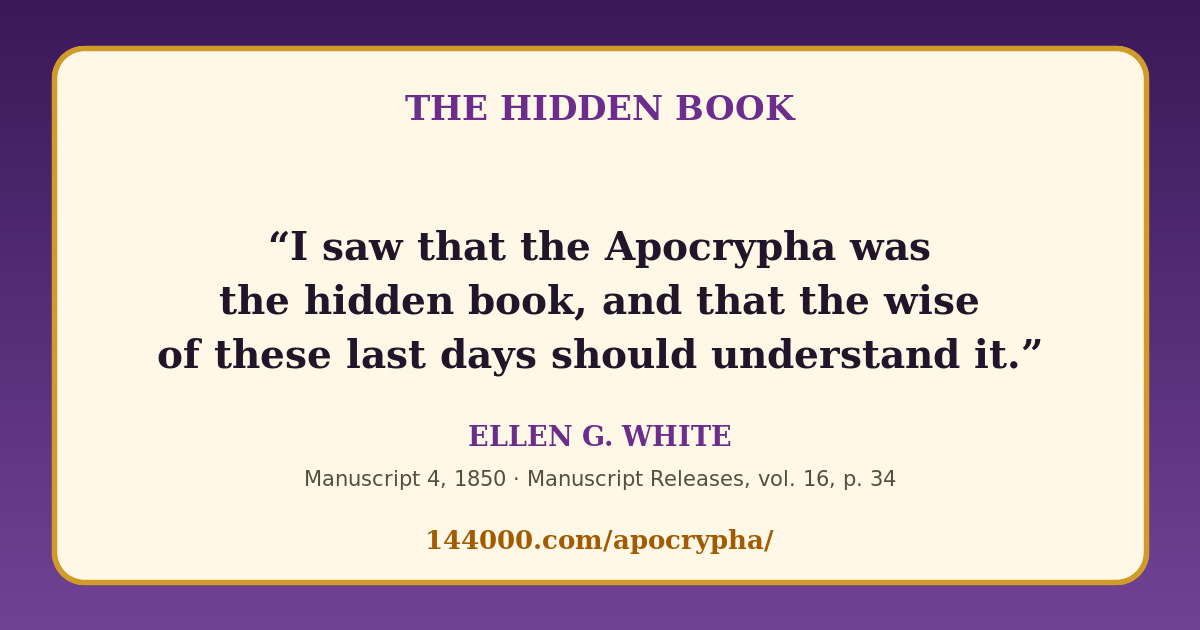
“I saw that the Apocrypha was the hidden book, and that the wise of these last days should understand it. I saw that the Bible was the standard Book, that will judge us at the last day. I saw that heaven would be cheap enough, and that nothing was too dear to sacrifice for Jesus, and that we must give all to enter the kingdom. I heard an angel say, ‘Think ye God will place His seal where there is an idol? No, no.’”— Ellen G. White, Manuscript 4, 1850; Manuscript Releases, vol. 16, p. 34.3. The complete passage appears in the featured quotation above.
“The 2nd book of Esdras, contains very important truths for those that keep God’s law and commandments; they will probably benefit no others.”— Captain Joseph Bates, A Seal of the Living God (1849), pp. 66–67.
“Concerning the Apocrypha, we regard portions of it as containing much light and instruction. If we were asked to specify, we should mention 2 Esdras, Wisdom of Solomon, and 1 Maccabees.”— “To Correspondents,” Review and Herald, August 5, 1858, p. 96; editorial staff included Uriah Smith, J. N. Andrews, James White, J. H. Waggoner, R. F. Cottrell and Stephen Pierce.
“The following is from 2 Esdras 16: ‘The more they deck their cities, their houses, their possessions, and their own persons, the more I will be angry with them, saith the Lord.’”— S. N. Haskell, “Remedy for Covetousness,” Review and Herald, June 20, 1871.
“2 Esdras 2. This is a most interesting chapter. It seems to me to give good evidence of inspiration. To the believer in present truth it is of especial interest.”— Early Adventist correspondence published in the Review and Herald, August 8, 1871.
No. They are scans of historical printed editions. The publication year and editor or translator are stated wherever known.
Her documented words were “the hidden book.” “Hidden manna” is the expression found in Revelation 2:17. The distinction is preserved throughout this page.
The embedded reader is convenient on phones and tablets. The PDF is useful for downloading, searching, citation and offline study.
Yes. Choose any “Play here” button in the audio library. The selected YouTube audiobook will load in the privacy-enhanced player on this page, and a direct YouTube link is also provided.
Both are unmistakably displayed in the Four Books of Maccabees scan room. Third Maccabees opens in the 1913 Oxford scan; Fourth Maccabees has a dedicated 1895 Cambridge scan. Both also have embedded audio, and the Library of Congress manuscript link opens a Greek codex containing III and IV Maccabees.
Yes. Open the 5 Maccabees entry to read Henry Cotton’s complete 1832 Oxford volume inside this page or download its files. The official Library of Congress catalog record is linked there. “Fifth Maccabees” is a later title applied to an Arabic Jewish historical work and is not part of the standard KJV Apocrypha.
Yes. The New Testament Apocrypha reading room links the infancy gospels, Gospel of Nicodemus, Thomas, Philip and Mary, the apocryphal Acts, three apocalypses, the Didache, Barnabas, Hermas, Clement, Ignatius, Polycarp, Laodiceans and the Paul–Seneca correspondence to embedded scans and downloads.
Begin with the Library of Congress catalog, then compare its records with the scanned collections linked throughout this page from the Internet Archive and Adventist Digital Library.
A historical library should never disguise a medieval work as a lost biblical manuscript or a nineteenth-century composition as a verified first-century record. Accurate identification strengthens serious study.